A Loaf from Hackney
There are certain things you carry with you from the places you have lived. A way of making coffee. A chair you refuse to part with. A particular loaf of bread.
For Maria, one of those things came from East London.
Long before Haus Mannenberg, there was Hackney. A part of London shaped by old workshops and warehouses, railway arches, markets, cafés and an unusually persistent culture of making things properly. It is a place where the everyday has a habit of becoming something people care deeply about — coffee, ceramics, bicycles, flowers and, perhaps above all, bread.
It was here that Maria developed her love for sourdough.
Not the complicated kind that requires discussion of hydration percentages over breakfast, but simply good bread: a dark crust, an irregular crumb, a little acidity and enough substance that very little needs to accompany it.
One of the places that became part of that ritual was E5 Bakehouse.
The bakery began beneath the railway arches near London Fields and became known for naturally leavened bread made with carefully sourced, stone-ground flour. Its best-known loaf, Hackney Wild, takes its name from the neighbourhood around it.
Years later and more than 900 kilometres away, the name has found its way into our kitchen at Haus Mannenberg.
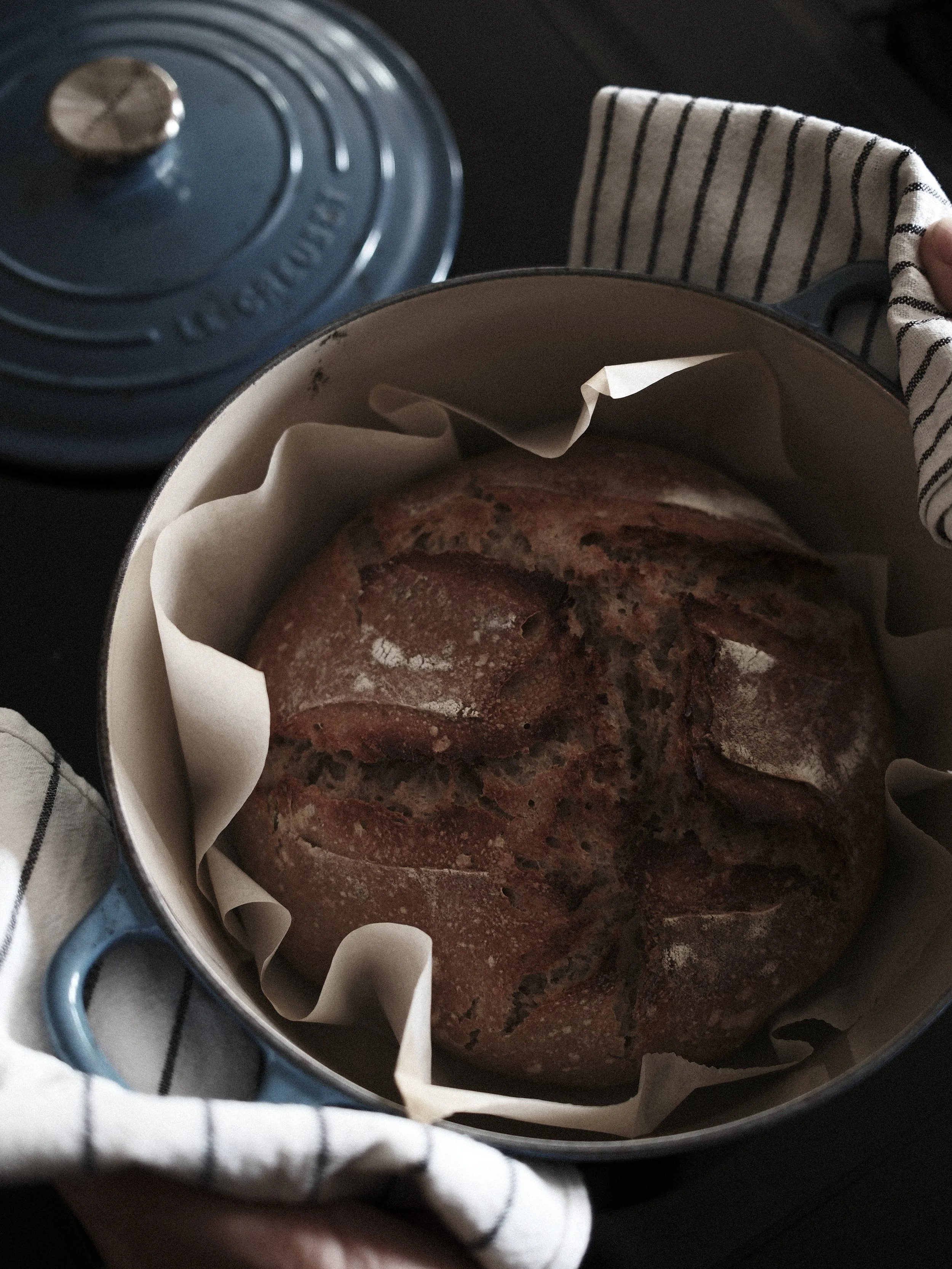
We bake Hackney Wild for our guests.
Not because sourdough is particularly fashionable, nor because a London bakery is an obvious reference for a centuries-old chalet in the Bernese Oberland. Quite the opposite. We like the slightly unlikely connection.
Outside the kitchen window are meadows, barns and the mountains above Mannried. The house itself has stood here for more than 300 years. Cows pass along the road. Church bells travel across the valley. On winter mornings, there may be fresh snow outside the door.
And somewhere inside, a loaf born beneath the railway arches of East London is slowly rising.
Flour, water, salt and time
There is something reassuringly uncomplicated about bread.
The ingredients are almost embarrassingly simple. What makes the difference is everything that cannot easily be added: patience, repetition and time.
A sourdough starter needs to be kept alive. The dough needs to rest. Fermentation follows its own timetable. There are shortcuts, of course, but taking them rather defeats the point.
Perhaps that is why making bread feels particularly at home here.
Haus Mannenberg was created around a similar idea. We wanted fewer things, but better ones. Objects that are useful as well as beautiful. Materials that improve rather than deteriorate with age. Food that does not need much explaining.
And mornings that are allowed to take a little longer.
The bread is mixed, folded, left to ferment and eventually baked until the crust is properly dark. Then comes the difficult part: leaving it alone for just long enough before cutting into it.
By breakfast, the smell has usually travelled well beyond the kitchen.
Things collected along the way
Not everything at Haus Mannenberg comes from the mountains.
That was intentional.
The house contains things and ideas we have collected from places that have mattered to us: Switzerland, London, Copenhagen, Vienna, Japan and elsewhere. Some are obvious — a chair, a coffee cup, a book. Others are less so.
A loaf of bread can carry a memory just as easily as a piece of furniture.
For us, the interesting part of a house is rarely whether everything belongs to the same style or period. It is whether the things inside it have a reason for being there.
The old timber walls of Haus Mannenberg sit alongside Danish furniture. Japanese outdoor objects appear next to pieces made in Switzerland. Coffee is prepared with beans roasted in Zurich. Skincare comes from the Bregenzerwald.
And breakfast occasionally begins in Hackney.
Perhaps that mixture is a more accurate reflection of how people live now. We travel, notice things, become attached to them and bring some of them home.
Over time they become part of our own rituals.
Bread for breakfast
There is no elaborate ceremony when Hackney Wild reaches the table.
It does not need one.
We serve it as bread should be served: freshly cut, preferably still a little warm, with good butter, preserves and whatever else happens to be on the breakfast table that morning.
Sometimes the simplest things are the ones people remember.
A fire already burning downstairs. Coffee being ground in the kitchen. Snow outside. Nowhere particularly urgent to be.
And a loaf of bread that has travelled, in its own way, from an East London railway arch to a 300-year-old house in the Swiss Alps.
We rather like that.