On a Sunday walk above Boltigen, the forgotten coal mines of the Simmental and an unexpected chapter of Swiss wartime history.
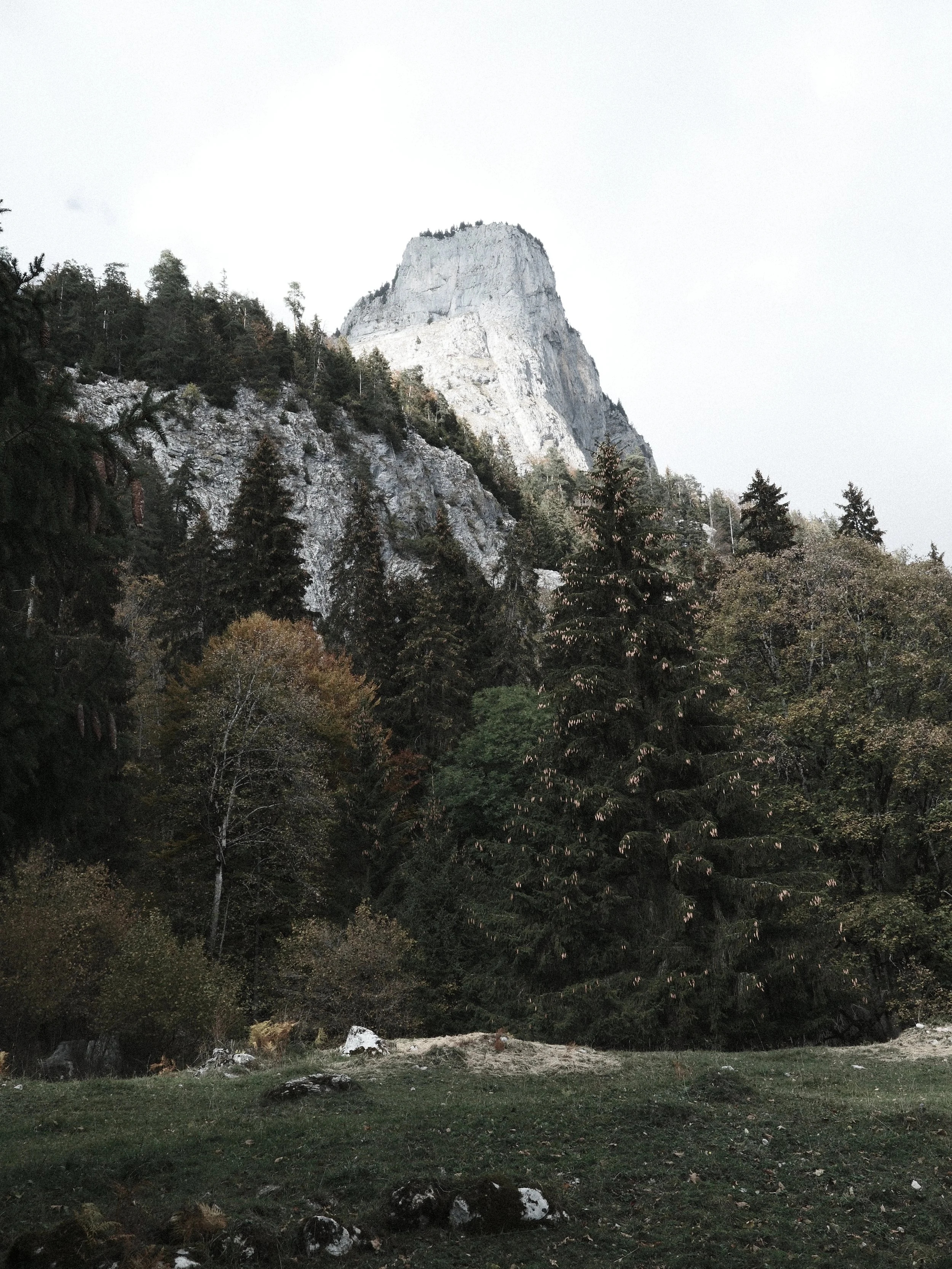
On a quiet Sunday in early November, we found ourselves walking through the woods beneath the Mittagflue, above the little village of Boltigen.
It was one of those beautiful autumn afternoons when there is no particular destination in mind.
The last golden leaves were falling from the trees, little streams made their way through moss-covered rocks, and old wooden farmhouses sat quietly among the meadows. Above everything rose the extraordinary limestone cliffs of the Mittagflue, dramatic and almost forbidding against the softer landscape below.
It is a peaceful place today.
But beneath these mountains lies a rather unexpected piece of Swiss history.
For centuries, the hills around Boltigen concealed something considerably less picturesque than their Alpine scenery might suggest.
Coal.
And during the Second World War, the quiet valleys around the Mittagflue became part of a remarkable mining operation.
When Switzerland Needed Coal
Switzerland remained neutral during the Second World War, but neutrality did not protect the country from the economic consequences of the conflict.
Coal was essential for heating, industry and transport. Much of it had traditionally been imported, but wartime restrictions and disrupted supply routes made obtaining sufficient fuel increasingly difficult.
Suddenly, Switzerland had to look much more closely at the resources beneath its own soil.
And one of the places it turned to was the Simmental.
Coal deposits had been known around Boltigen since the eighteenth century. The first mining concessions were granted in 1760, and extraction continued intermittently throughout the following hundred years.
Mining was never especially easy or consistently profitable here. The seams were narrow, the terrain difficult and transporting coal down from the mountains presented its own challenges.
But during periods of shortage, these otherwise marginal deposits became valuable.
The First World War brought a renewed interest in mining. Then, in the early 1940s, the Second World War created another, much more intensive period of activity.
The Mines Beneath the Mountain
Between 1941 and 1948, coal mining became an important, if temporary, industry in this part of the Bernese Oberland.
Three principal mining operations worked the deposits around Schwarzenmatt, Boltigen and Oberwil.
One of them had its entrance in the Tubetal, also known as Taubental, beneath the Mittagflue and the neighbouring Holzerhore.
Here, miners dug their way into the mountainside, following thin seams of coal through layers of ancient rock.
Some of these deposits measured just ten to fifty centimetres in thickness.
It is difficult to imagine the physical effort required to extract coal from such confined spaces.
Across the three main mines, around one hundred men worked in three shifts, keeping the operations running day and night.
Their reported hourly wage was CHF 1.20.
Several kilometres of underground passages were excavated to reach the coal, and at the height of production the quantities extracted were considerable. The Schwarzenmatt mine alone produced more than 5,000 tonnes in 1945.
For a quiet Alpine valley, it must have been an extraordinary transformation.
A Very Different Life Underground
Today, the woods beneath the Mittagflue are filled with the sound of birds, running water and the occasional cow grazing nearby.
Eighty years ago, life here would have been rather different.
Contemporary accounts of mining in the Simmental describe exceptionally difficult working conditions.
Protective equipment was rudimentary. The miners worked amid dust, unstable rock and the constant danger of collapse. Mechanical drilling could fill the confined passages with particles that made breathing difficult.
A simple work coat and ordinary hat were often all the protection a miner had.
The work was demanding, dangerous and, for many, damaging to their health.
There was also the extraordinary challenge of transporting the coal.
At the neighbouring Schwarzenmatt mine, a small inclined railway used gravity to lower loaded wagons from the mine entrance, simultaneously pulling empty wagons uphill.
It was practical engineering in an extremely difficult landscape.
And it is fascinating to think that these quiet slopes, now covered by woodland and walking paths, once supported an entire network of industrial activity.
An Even More Unexpected Chapter
The history becomes stranger still.
Research into the military fortifications around Boltigen suggests that the former Taubental mine workings also played a part in Switzerland's wartime defence infrastructure.
Military documentation from 1944 identifies a telephone exchange associated with the tunnels, while accounts of the site's later history mention ammunition storage.
The Simmental itself formed part of Switzerland's defensive landscape, with road barriers, anti-tank obstacles and fortified positions established along important routes through the valley.
It is an extraordinary contrast to the peaceful countryside we know today.
A landscape of old farmhouses, waterfalls and grazing cattle concealing the remains of coal mines, military communications and defensive installations.
The Mountain Remembers
Eventually, the war ended, international trade resumed and mining in the Simmental became uneconomic once more.
By 1948, the major operations had closed.
Equipment was removed, passages were abandoned and nature gradually reclaimed much of the landscape.
Today, many of the original mine entrances have collapsed or become difficult to identify. Much of what remains is hidden beneath vegetation or deep within unstable underground workings.
Fortunately, this unusual part of local history has not been entirely forgotten.
The association Freunde Kohlenbergwerke Boltigen has been working to preserve the mining heritage of the region, particularly around the former Schwarzenmatt workings.
Its plans include an educational trail, a museum experience and the possibility of making a carefully secured section of the old mine accessible to visitors.
As recently as 2026, the municipality of Boltigen was considering the planning framework for this heritage project.
It is a wonderful initiative, not least because the history of these mines is also the history of the people who worked in them.
Their lives and labour deserve to be remembered.
A Sunday in November
We knew a little about the mining history before our walk, but exploring the landscape beneath the Mittagflue made it all seem much more tangible.
The cliffs, the old paths, the steep wooded slopes and the streams running down towards the valley suddenly belonged to a much larger story.
And that is one of the things we love most about this part of Switzerland.
There is so much more here than beautiful scenery.
Every village, farmhouse and mountain has its own history, sometimes stretching back centuries, sometimes connected to events far beyond the valley.
And occasionally, an ordinary Sunday walk reveals something entirely unexpected.
We eventually made our way home towards Haus Mannenberg, leaving the Mittagflue behind us as the afternoon light began to fade.
The old mines were quiet.
The leaves continued to fall.
And beneath the mountain, a fascinating chapter of the Simmental's history remained largely out of sight.
Boltigen, Simmental — November 2026.