On concrete, craftsmanship and the forgotten hands behind one of London's most remarkable architectural landmarks.
There are buildings that reveal themselves immediately, and others that ask you to look a little closer.
London's Barbican is certainly one of the latter.
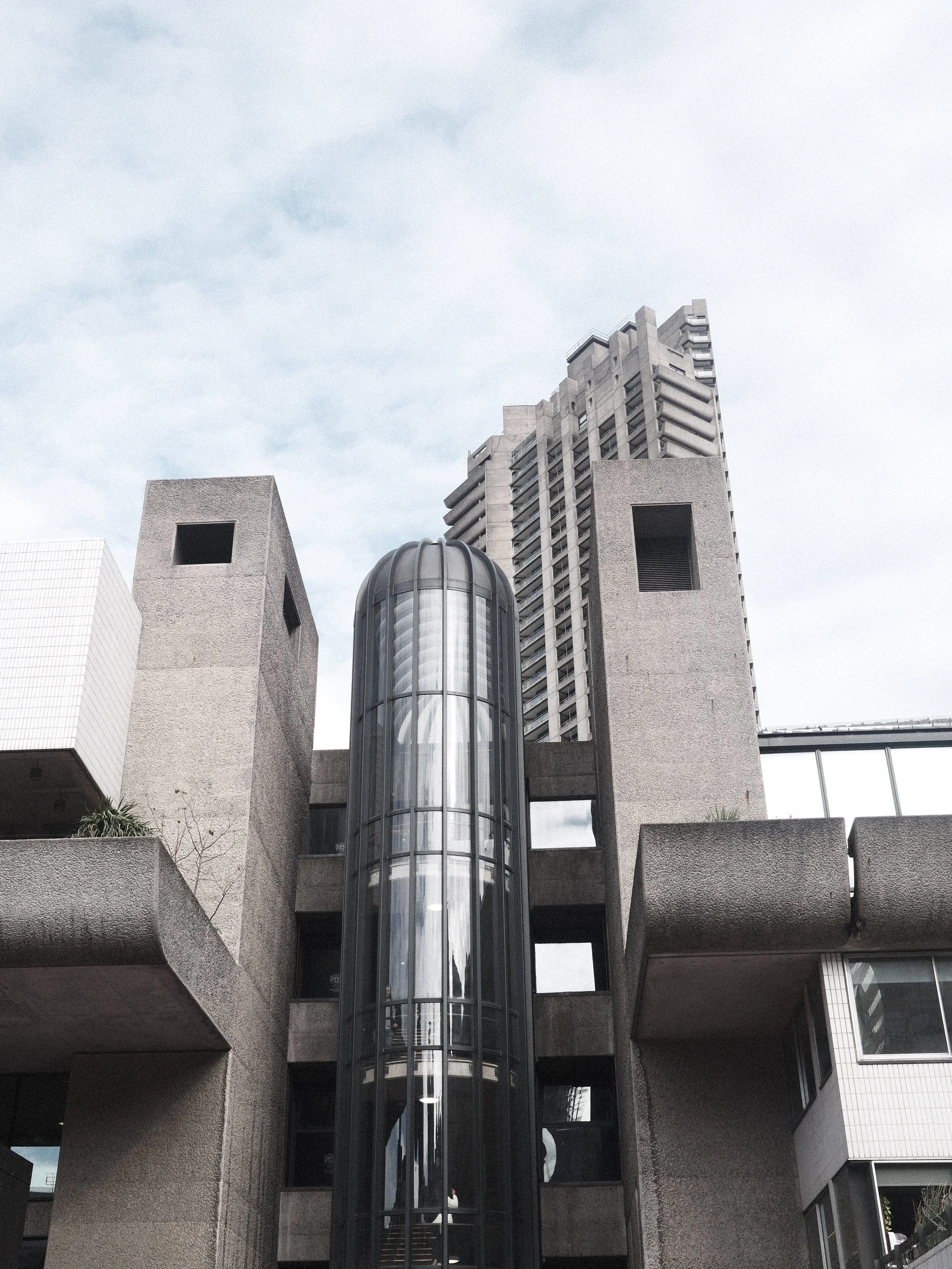
During a recent visit to the city, Maria spent time exploring this extraordinary complex of concrete towers, elevated walkways, gardens and hidden courtyards.
It is a place that inspires strong opinions. Some find its monumental architecture forbidding, others consider it among the finest examples of twentieth-century design.
But the longer you spend there, the more fascinating it becomes.
Especially when you begin to understand how it was made.
A New City from the Ruins
The story of the Barbican begins not with concrete, but with destruction.
During the Second World War, much of this part of the City of London was devastated by German bombing.
What had once been a densely populated neighbourhood of warehouses, workshops, homes and narrow streets was largely reduced to ruins.
In the years that followed, architects Chamberlin, Powell and Bon were commissioned to imagine an entirely new kind of urban neighbourhood.
Their vision was ambitious.
Rather than simply reconstructing the old streets, they proposed an almost self-contained city, with residential towers, gardens, schools, cultural institutions and pedestrian routes elevated above the traffic.
Construction began in the 1960s, and the Barbican Centre eventually opened in 1982.
The result was extraordinary.
A landscape of monumental concrete, softened by water, planting and carefully considered spaces between buildings.
But the material that gives the Barbican its unmistakable character has a remarkable story of its own.
Concrete, Made by Hand
At first glance, the Barbican appears to be constructed from enormous blocks of roughly textured stone.
Its columns, walls and balconies have an almost geological quality. Their surfaces are irregular, weathered and surprisingly tactile.
Yet that distinctive finish was not created when the concrete was poured.
It was made afterwards, by hand.
The concrete was initially cast into timber moulds, known as shuttering, and left to harden for approximately 28 days.
Only then did workers begin the laborious process of breaking away its smooth outer surface.
Using picks and vibrating hammers, they chipped into the concrete to expose the small pieces of granite aggregate beneath.
The technique, known as pick-hammering or bush-hammering, produced the rough, deeply textured surface that has become synonymous with the Barbican.
It also helped disguise the horizontal joints left where successive sections of concrete had been poured.
The architects wanted a material that would age gracefully, developing an even, stone-like appearance rather than simply looking stained or weathered.
And so, somewhat paradoxically, the appearance of raw, unfinished concrete required an extraordinary amount of additional work.
Every mark was made by someone.
The Hands Behind the Architecture
What makes this story particularly interesting is the history of the people who carried out that work.
At the height of construction, around a thousand workers were employed across the Barbican building sites.
They came from different parts of Britain and from much further afield.
Large numbers were Irish, while others came from Jamaica, elsewhere in the Caribbean, India and Eastern Europe.
They were part of the generation of workers whose skills and labour helped transform postwar Britain.
And yet their contribution is rarely the first thing mentioned when discussing the Barbican.
Research by the University of Westminster, based on interviews with former construction workers, reveals a fascinating and sometimes troubling picture of life on the building site.
The distinctive concrete finish was produced by a small group of Black workers, who spent long days operating heavy vibrating tools against the hardened surfaces.
It was exhausting and dirty work.
The constant vibration could cause lasting damage to nerves and blood vessels in the hands, a condition commonly known as vibration white finger. Airborne concrete dust created additional respiratory hazards.
Protective equipment was far less sophisticated than it is today.
One former worker remembered how physically demanding it was to hold the hammering equipment throughout the day.
It is a striking thought.
The texture that architects and photographers now admire was created through an intensely physical process, by workers whose names are largely absent from the familiar architectural history.
The Barbican's concrete is not merely an expression of an architect's vision.
It is also a record of human labour.
The Battle of the Barbican
The construction of the estate was not without conflict.
Between 1965 and 1967, a series of disputes over pay, safety and working conditions became known as the Battle of the Barbican.
Workers protested against inadequate facilities, difficult working conditions and the treatment of trade union representatives.
Some recalled having to walk as far as St Paul's Cathedral simply to use a proper toilet.
The industrial disputes were prolonged and, at times, bitter. Workers lost their jobs, some faced blacklisting, and construction was repeatedly delayed.
These events became an important chapter in the history of Britain's building trade unions.
It is a side of the Barbican that visitors rarely encounter.
Today, the concrete is celebrated for its sculptural beauty and architectural importance. But behind that beauty lies a much more complicated history of migration, physical labour and the struggle for better working conditions.
Understanding this doesn't diminish the achievement of the architecture.
It gives it another dimension.
A Material That Remembers
Perhaps what Maria found most fascinating was the way the Barbican's concrete seems to hold the history of its making.
Look closely and the surfaces are anything but uniform.
There are variations in texture, subtle changes in colour and the marks of the tools used to shape them.
Although the buildings are monumental in scale, their surfaces reveal something unexpectedly human.
And this is where an unlikely connection to Haus Mannenberg begins.
Our chalet in the Bernese Alps could hardly be more different.
Built more than three centuries ago, it is a house of timber, stone and traditional Alpine construction, surrounded by meadows and mountains rather than London streets.
Yet during the three years we spent restoring it, we became increasingly conscious of something that the Barbican expresses in an entirely different architectural language.
Materials carry stories.
The old wooden beams at Mannenberg reveal the marks of the tools that shaped them, the irregularities of hand construction and the gradual effects of centuries of use.
These details were never something we wanted to conceal.
They were precisely what made the building worth preserving.
At the Barbican, concrete that might have remained smooth and anonymous was deliberately worked to create texture, depth and character.
In both places, the surfaces tell us something about the hands that made them.
Of course, there is an important distinction. The historical craftsmanship of an old Alpine house and the difficult working conditions of a twentieth-century construction site are not the same thing.
But both remind us that architecture is more than an image or a drawing.
Every building is the result of human decisions, skills and effort.
Beauty in Unexpected Places
There are other surprises at the Barbican.
Despite its uncompromising appearance, the estate contains an extraordinary amount of greenery, quiet gardens and water.
Its elevated walkways offer unexpected views through the buildings, while the conservatory creates an almost tropical landscape among the concrete structures.
Even fragments of London's ancient Roman and medieval walls survive within the complex.
Old and new exist side by side, sometimes separated by nearly two thousand years.
It is a reminder that cities, like houses, are never truly finished.
They accumulate layers of history, changing as successive generations inhabit and reinterpret them.
And perhaps that is what makes the Barbican so compelling.
It is not simply a celebrated example of Brutalist architecture.
It is a place shaped by war, reconstruction, immigration, ambition, craftsmanship and the everyday lives of the people who have lived and worked there.
Looking Beyond the Surface
By the end of Maria's visit, the concrete seemed to tell a different story.
What had first appeared monumental and severe became something far more intricate.
A surface shaped by tools and hands. A building made possible by people from many different backgrounds. A place whose imperfections, history and extraordinary ambition have gradually become part of its character.
It is easy to appreciate architecture for its appearance.
More rewarding, perhaps, is understanding what lies beneath it.
Whether we are looking at the rough concrete of the Barbican or the old timber walls of Haus Mannenberg, the most interesting details are often those that reveal how something was made, who made it and how it has endured.
And sometimes, the longer you look, the more there is to discover.
London, autumn 2026.