Why Gstaad Is Only Part of the Story
Most journeys to this part of Switzerland begin with a single name.
Gstaad.
For decades it has occupied a unique place in the imagination, equally associated with Alpine farming traditions and international visitors, with grand hotels and quiet mountain pastures. It is one of those rare places that has managed to become globally recognised without entirely losing sight of the landscape that first gave it meaning.
It is also, perhaps, only the beginning of the story.
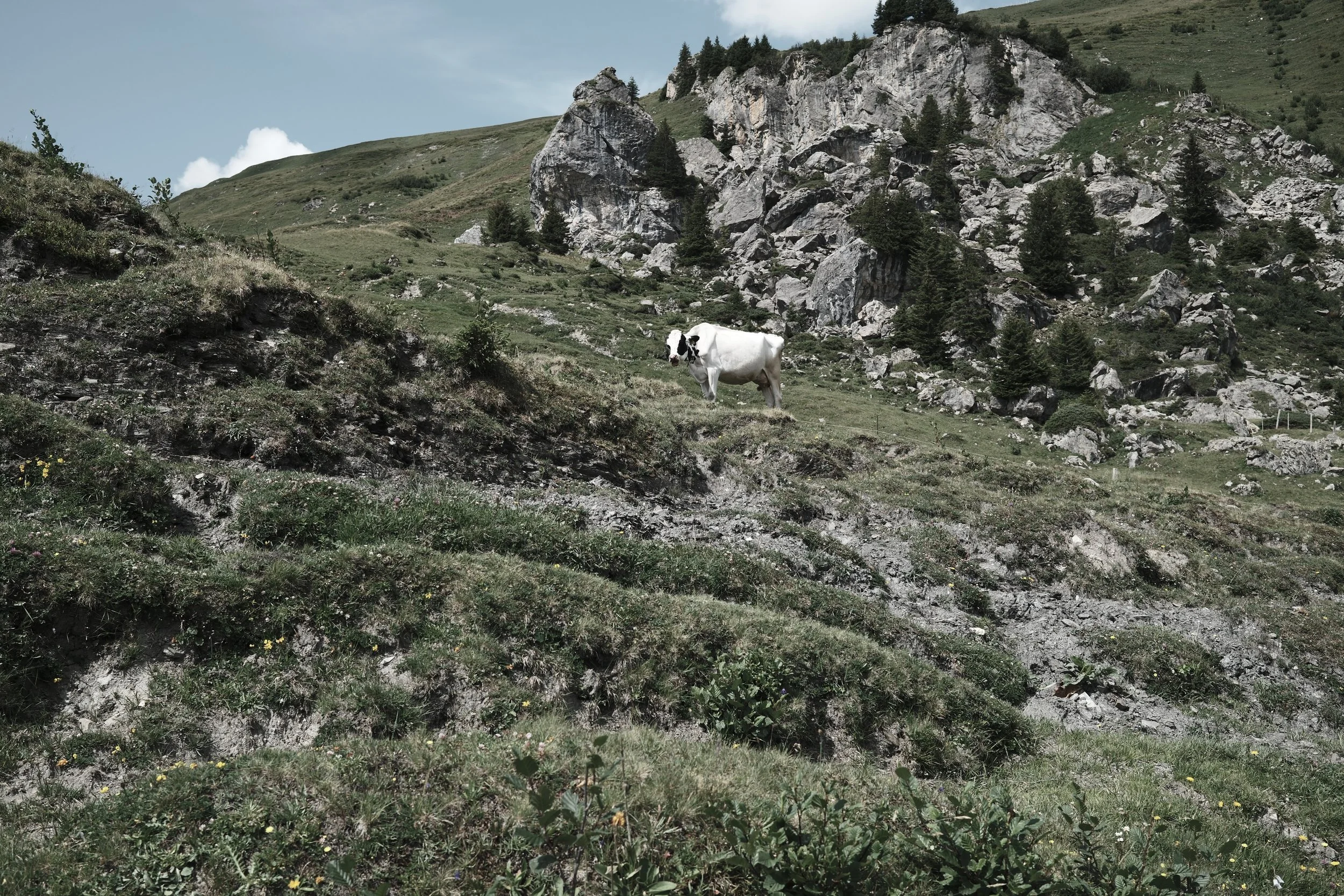
Spend a little longer here and another geography slowly comes into focus. The roads become quieter. Railway stations grow smaller. Villages appear that are absent from guidebooks yet have shaped the region for centuries. The valleys begin to reveal themselves not as separate destinations but as parts of a much older network of rivers, mountain passes, farms and settlements.
Haus Mannenberg stands in Mannried, just outside Zweisimmen, at a point where several of these landscapes meet. To the east lies the broad Simmental, with its historic farmhouses and working agricultural landscape. To the south-west, the Saanenland unfolds through villages such as Saanen, Schönried and Gstaad before continuing towards Rougemont and Château-d’Œx, where the language quietly changes from German to French while the mountains remain reassuringly familiar.
It is an unusual position.
Within little more than half an hour, entirely different Alpine worlds become accessible, each with its own architectural language, history and rhythm of daily life.
That diversity is easy to overlook.
The mountains are so spectacular that they often become the whole story. Yet landscapes are never shaped by scenery alone. They are shaped by people—by farmers deciding where woodland should end, by rivers determining where villages could grow, by railway engineers linking valleys that had once been separated by winter snow, and by generations who understood that living in the Alps meant adapting to them rather than conquering them.
This becomes visible in surprisingly ordinary moments.
A carved inscription above the entrance to a farmhouse. Hay drying beneath the summer sun. The first train arriving in Zweisimmen on a winter morning. The changing profile of church towers as one valley becomes another. Details that seem insignificant on their own but, together, begin to explain why this region feels unlike anywhere else.
Perhaps that is why we chose Mannried.
Not because it sits beside one famous destination, but because it quietly belongs to many.
From here, it is just as natural to spend a morning walking through the medieval streets of Saanen as it is to continue west towards the French-speaking villages of the Pays-d’Enhaut, or east into the quieter reaches of the Simmental. None replaces another. Together they form a landscape that rewards curiosity far more than haste.
There is a temptation, when travelling, to collect places.
This region encourages something different.
To return to the same bakery.
To notice how the light changes across the valley in late autumn.
To recognise the sound of cowbells before seeing the herd.
To take the slower train instead of the faster road.
To understand that some of the most memorable discoveries are not destinations at all, but relationships between places.
That, perhaps, is the true character of this corner of Switzerland.
Not a collection of highlights.
A connected landscape that gradually reveals itself to those willing to look a little closer.